_ed.png)

Maybe it is the stairs. Maybe it is the bottom of a squat, the landing after a jump, or mile three of a run that used to feel easy. Wherever it shows up, knee pain has a way of quietly editing your life, one modified workout and one skipped activity at a time.
Most people respond to that by resting, icing, and hoping it resolves. Sometimes it does. More often, it comes back the moment training resumes, because rest addressed the symptom without ever touching the reason the knee was overloaded in the first place.
At EVO Performance Therapy, we treat knee pain differently. We do not start with your knee. We start with everything connected to it: how your hip moves, how your ankle absorbs load, how your strength is distributed, and how your training has been asking more of your knee than it has been prepared to handle. That is where the real answer usually lives.
Your knee is rarely the problem.
It is usually just where the problem shows up.
Schedule a Performance Therapy Evaluation
Learn How EVO Helps Active Individuals Return to the Activities They Love

If nothing traumatic happened, why does it suddenly hurt to go up the stairs?
That is one of the most common and most frustrating questions we hear. No fall, no twist, no single moment you can point to. Just pain that showed up and has not fully left since.
Knee pain like this rarely comes from one dramatic event. It builds. A hip that has quietly lost strength over the years. An ankle that does not move the way it should, so your knee compensates every time you land, squat, or push off. A jump in training volume that outpaced what your tissue was ready to absorb. A strength imbalance between your quad and your hamstring that has been shifting stress to the front of your knee for months without you noticing.
The knee is a hinge joint sitting between two of the most mobile and demanding joints in the body: the hip above it and the ankle below. When either of those is not doing its job, the knee often ends up absorbing the difference. That is why the location of your pain does not always point to its source.
This is the foundation of how we treat knee pain at EVO. We are not just asking where it hurts. We are asking what is asking too much of it.
UNDERSTANDING KNEE PAIN
Why Your Knee May Actually Hurt.


Whatever Is Going On With Your Knee, We Have Likely Seen It Before.
Runner's Knee
Patellofemoral Pain Syndrome
The dull, aching pain around or behind the kneecap that flares up on runs, stairs, or long periods sitting with a bent knee. Often tied to hip weakness, quad imbalances, or mechanics that shift more load onto the front of the knee than it is built to handle.
Patellar Tendonitis
Jumper's Knee
Pain just below the kneecap that flares with jumping, sprinting, and explosive movement. This is a tendon overload issue, and tendons respond to specific, progressive loading, not rest alone.
COMMON KNEE CONDITIONS WE TREAT
Knee pain shows up differently for everyone. Below are some of the conditions we most commonly treat, each requiring its own understanding of what is driving it.
ACL Injuries
Tears and Post-Reconstruction Recovery
Whether you are early in recovery after reconstruction or working through a partial tear conservatively, ACL rehabilitation is about far more than regaining range of motion. It requires rebuilding strength, control, and confidence before you are ready to cut, pivot, or land at full speed again.
Knee Osteoarthritis
Active Adults Managing Joint Changes
Cartilage changes do not have to mean the end of an active lifestyle. Strength, mobility, and movement quality directly influence how an arthritic knee feels and functions, and building all three back up is often the most effective path to moving with confidence again.
Meniscus Tears
Twisting Injuries and Mechanical Symptoms
That catching, locking, or giving-way sensation usually traces back to a twisting injury, though it can also develop gradually. Depending on the tear and your goals, treatment may focus on conservative rehabilitation or on preparing your knee for and recovering from surgery.

HOW PERFORMANCE THERAPY HELPS
Fixing the Knee Means Looking Past It.

A Movement Assessment That Looks Beyond the Knee
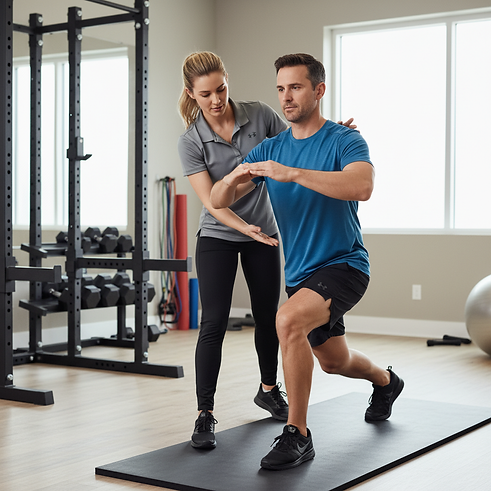
Every plan starts with a comprehensive evaluation of how your entire body moves, not just how your knee bends. We assess hip and ankle mobility, strength symmetry between your legs, single-leg control and balance, and how your knee behaves under the specific demands of running, squatting, jumping, or whatever activity matters most to you. This is what tells us why your knee has been asked to do more than it should.
Building the Strength and Capacity Your Knee Is Missing
Knee pain often persists because the structures around the knee, particularly the hip and the quadriceps, are not strong enough to support the demands being placed on them. Treatment is built around closing that gap: quad strength, hip strength, single-leg control, and the tissue tolerance that lets your knee absorb load without breaking down.
A Clear Path Back to Performance
Recovery is not the finish line. Whether your goal is returning to running, getting back under a barbell, playing your sport again, or simply training without the fear of your knee giving out, your plan is built around that specific outcome from day one, with a progression designed to get you there.

Performance therapy for knee pain at EVO is built on a simple premise: resolve what is actually causing the problem, and build the physical capacity to keep it from coming back.
WHAT TO EXPECT
Your First Few Weeks at EVO
Every client starts with a thorough evaluation: your injury history, what has and has not worked before, the movement patterns and strength limitations we uncover in the assessment, and the specific goals you are working toward. From there, we build a plan combining exercise progression, hands-on treatment when it will genuinely accelerate your results, and movement retraining focused on your sport or activity.
Progress gets tracked in terms that actually matter: improved movement quality, measurable strength gains, growing confidence in the knee under load, and real steps back toward the activities you came in wanting to return to.
TRAINING WITH KNEE PAIN
Can You Exercise With Knee Pain?
Should you stop running the moment your knee starts to hurt?
Usually not, and this surprises a lot of people. Complete rest is rarely the answer, because it does nothing to address the strength or mobility deficit that caused the pain, and it often costs you fitness and muscle that make the knee more vulnerable once you start training again.
The better question is not whether to move. It is how much, how intensely, and in what specific way, based on what your knee can currently tolerate and what it needs to build toward. That is a moving target, and it is exactly what a movement assessment is designed to answer.
Lifting with knee pain, running with knee pain, playing your sport with knee pain: in many cases, all of these remain possible with the right modifications and the right plan. The goal is not avoiding movement. It is finding the right movement for where your knee is right now.

"
“What was great is how he was able to incorporate the rehabilitation process into my lifestyle. I try to stay active and I was scared that to fix my knee issues, I would have to rest and lose strength, and that was not true. After a couple of months, I am already training without restriction and feeling as strong as ever. That is coming from a place where I could not go up stairs without pain in my left knee.”
Brad W. EVO Performance Therapy Client
LONG-TERM PREVENTION
Preventing Knee Pain From Coming Back
-
Build the strength that got skipped: Most recurring knee pain traces back to a strength deficit, usually in the hip or the quad, that was never fully closed. Long-term resilience means training past the point where symptoms disappear.
-
Improve movement quality, not just pain levels: Feeling better and moving better are not always the same thing. We continue refining mechanics, even after pain resolves, so your knee is prepared for real training demands, not just daily life.
-
Manage training volume intelligently: Sudden jumps in mileage, load, or intensity are one of the most common triggers for knee injuries in active adults. Learning how to progress your training without outpacing your tissue's capacity is a skill, and one we help you build.
-
Recover the way your training demands: How you recover between sessions directly affects how much stress your knee can absorb before symptoms return. We help you understand what your recovery actually needs, not just what feels good.
-
Prepare your body for what you are asking of it: Whether that is a marathon, a heavier squat, or simply keeping up with your kids, your knee performs best when it has been specifically prepared for the demands you are placing on it, not just generally strengthened.
Resolving your current knee pain is only half of the work. The other half is making sure it does not return the next time your training gets harder, your mileage goes up, or life just asks more of your body.
WHEN TO SEEK CARE
Some knee discomfort resolves with a few days of lighter activity. But certain signs suggest it is time for a proper evaluation rather than more waiting.
-
Pain that has lasted more than 2 or 3 weeks without meaningful improvement
-
Swelling that keeps returning, especially after activity
-
A feeling of instability, or your knee giving way unexpectedly
-
Modifying or avoiding workouts because of how your knee feels
-
Avoiding activities you used to enjoy because you are worried about your knee
-
The same knee issue resurfacing again and again despite rest or previous treatment
If any of these sound familiar, that is your knee asking for a real answer, not another round of rest and hope. A movement assessment is where that answer starts.
When Should You See a Physical Therapist for Knee Pain?

FREQUENTLY ASKED QUESTIONS
Common Questions About Knee Pain Treatment
Do I need physical therapy for knee pain, or will it just go away on its own?
Some minor knee irritation resolves on its own with a few days of reduced load. But knee pain that lingers beyond a couple of weeks, keeps coming back, or changes how you move is telling you something. It usually means a movement deficit, a strength imbalance, or a loading problem has not been addressed, and it will keep resurfacing until it is. The sooner that gets evaluated, the shorter and simpler the fix tends to be.
Can I keep training while my knee hurts?
In most cases, yes, and we would rather help you train through it intelligently than tell you to stop completely. Complete rest rarely solves the underlying issue and often leads to lost strength that makes the knee more vulnerable once you return. The better question is not whether to move, but how much, how intensely, and in what way. That is exactly what a movement assessment tells us.
What actually causes knee pain in active adults?
Far more often than people expect, the knee is the messenger, not the source. Hip weakness, ankle stiffness, quad and hamstring imbalances, and training load that has outpaced your body's current capacity all funnel additional stress into the knee joint. Treating the knee alone without addressing what is feeding it usually means the pain returns.
Is knee pain a normal part of getting older or staying active?
Wear and tear is real, but constant knee pain is not something you are supposed to just accept. Active adults in their 40s, 50s, and beyond regularly return to running, lifting, and sport with the right combination of strength work, mobility training, and load management. Age changes what your knee needs. It does not mean your knee has to hurt.
How long does it take to resolve knee pain?
It depends on what is driving it, how long it has been building, and what you are training for. Some clients feel meaningfully better within a few sessions. Others, particularly those managing more complex or longstanding issues, are looking at a few months of progressive work. What we can tell you upfront is that your plan will be built around your specific findings and your specific goals, not a generic timeline.
What if I already had knee surgery? Can performance therapy still help?
Yes. Whether you are early in a post-surgical recovery or you had surgery years ago and never fully got back to where you want to be, a movement assessment can identify what is still holding you back. Post-surgical knees often carry compensation patterns long after the incision has healed, and those patterns are entirely addressable.
EVO PERFORMANCE THERAPY
Stop Managing It. Start Fixing It.
Knee pain does not have to be something you work around indefinitely. With the right assessment, the right plan, and the right team, most active adults get back to running, lifting, and competing stronger than they were before the pain started.
Schedule your Performance Therapy evaluation today and find out what is actually driving your knee pain, and what it will take to put it behind you.
READY TO GET STARTED?
Schedule a Performance Therapy Evaluation | Get Back to the Activities You Love
615-266-5599 | evoperformancetherapy.com