

Performance therapy for neck pain, stiffness, and headaches, for professionals hunched over a desk and athletes locked under a bar overhead alike.
Nobody thinks about their neck until it stops cooperating. Then it is everywhere. Checking a blind spot in the car. Glancing over your shoulder when someone calls your name. Reaching overhead mid-set and feeling something catch instead of simply moving. Waking up already stiff before your day has even started. What used to happen without a single thought now takes calculation.
Here is part of why. Your head weighs somewhere between ten and twelve pounds, roughly the weight of a bowling ball, and your neck holds that weight upright through every one of your waking hours, all while still turning, tilting, and reaching in nearly every direction. Holding that much weight steady, for that long, takes more than just a strong neck.
A bowling ball is heavy to hold for a minute. Your neck holds one all day.
Ask most people why their neck hurts and the answer is posture. That is probably part of it. But holding that much weight steady, for that long, while still turning and reaching in nearly every direction, involves a lot more than how you sit at your desk.

Posture is the easy answer, and it is not wrong, just incomplete. Here is what else tends to be involved:
-
Baseline tension carried in from poor sleep or a demanding stretch at work, since a neck that starts the day already braced has far less room to absorb everything else you ask of it
-
Endurance limitations in the deep neck flexors and upper back, the muscles responsible for holding your head up for hours, not just moving it
-
Limited cervical rotation or extension, which forces compensations elsewhere during everyday movements like backing out of a driveway or reaching into the back seat
-
Upper back stiffness, since a thoracic spine that does not extend well shifts extra demand onto the neck to create the same range of motion
-
Shoulder mechanics, particularly overhead reaching and pressing, which place real demand on the muscles connecting your neck to your shoulder blade
-
Training demands that increased faster than your neck was prepared for, heavier overhead work, more volume, new positions under load
-
An old injury or a whiplash event that never fully resolved, leaving guarding patterns that quietly persist long after the initial injury healed
UNDERSTANDING NECK PAIN
What We Actually Look At When Your Neck Hurts


Here is what that often looks like in practice. When your upper back loses mobility, your neck rotates and extends more than it should every time you check a mirror or look overhead. When the deep muscles at the base of your skull lose endurance, the larger, more superficial muscles in your neck and shoulders take over and stay tight trying to do a job they were never built to hold alone.
This is why an evaluation that looks only at your neck often misses the full picture. The neck reports on problems. It does not always cause them.

Common Neck Conditions We Treat
General Neck Pain
Acute and Chronic Stiffness or Aching
Whether it came on suddenly or has been a background presence for months, general neck pain almost always responds to the same core question: what has your neck stopped tolerating, and how do we rebuild that tolerance safely and progressively.
Cervical Disc Issues and Nerve Symptoms
Radiating Pain, Tingling, or Numbness Into the Arm
When pain, tingling, or numbness travels down the arm, it usually means a structure in the neck is irritating or compressing a nerve. Identifying the movement and postural factors contributing to that irritation is often the fastest path to relief.
COMMON NECK CONDITIONS
Neck pain shows up differently depending on what is driving it. Here is what we most often see, and what is usually behind it.
Neck-Related Headaches (Cervicogenic Headaches)
Headaches That Start at the Base of the Skull
Headaches connected to neck stiffness, especially ones that begin at the base of the skull, are more common than most people realize, and treating the neck directly is often the missing piece.
Athletic Neck Pain
Contact Sports, Overhead Lifting, and Repetitive Strain
Contact sports, heavy overhead lifting, and repetitive training positions all place demands on the neck that daily life does not. Getting back to full training requires a plan built around those specific demands, not a generic stretch-and-rest protocol.
Whiplash and Neck Injuries
Car Accidents, Collisions, and Acute Trauma
Whiplash and other acute neck injuries often involve more than sore muscles. A gradual, well-sequenced return to normal movement and loading is usually what determines whether symptoms resolve completely or quietly linger for months.

HOW WE HELP
Treating the Neck by Treating What Surrounds It

An Assessment That Includes Your Upper Back and Shoulders
We evaluate cervical mobility, upper back extension, shoulder mechanics, and postural endurance together, not in isolation. This tells us whether your neck is the actual source of the problem or simply the part absorbing the consequences of a limitation somewhere else.
Building the Endurance Your Neck Actually Needs
Most neck plans focus on stretching a tight muscle for a few minutes. We focus on building the endurance capacity of the deep neck flexors and upper back so they can hold up under the sustained demands of your workday, your training, or both.
Restoring Mobility Where You Have Actually Lost It
Whether that is rotation for a golf swing or a batting stance, extension to look overhead, or thoracic mobility that has quietly stiffened over years at a desk, we restore the specific ranges you need, not motion for its own sake.
A Return to Training Without Guarding
Whether your goal is going back overhead in the gym, returning to a contact sport, or simply getting through a workday without a headache, your plan is built toward that specific outcome, with progressive loading designed to get you there confidently.


"
“I am very thankful for the EVO team. They have helped me get back into the gym full swing and were pleasing to work with along the way. I came to them after having several months of upper back and neck pain that was steadily getting worse and was stopping me from being able to live my normal active lifestyle. I had been working with a doctor and another PT practice and had not made any progress, so my doctor was suggesting surgery. I had heard EVO was great for athletes, especially CrossFit athletes, so I decided to try them in hopes I would not eventually need surgery. After just a few weeks I started seeing small progress, and after 2 months my pain was nearly all gone and I was able to get back to pushing hard in the gym. Not only have they gotten me back in full swing, but they have taught me how to take better care of my body.”
Robert Stevens EVO Performance Therapy Client
NECK PAIN AND HEADACHES
When a Headache Is Actually a Neck Problem in Disguise
Not every headache has anything to do with your neck. Migraines, sinus headaches, and tension headaches tied to stress or dehydration are real and separate conditions. But a specific subset of headaches, ones that start at the base of the skull, often on one side, and seem to track with how stiff or irritated your neck feels that day, are what we call cervicogenic headaches: headaches that originate from the joints and muscles of the upper neck rather than the brain itself.
The giveaway is usually the pattern. If your headache gets worse after a long day at a desk, after a hard session that loaded your neck and upper back, or after sleeping in an unusual position, and it tends to ease with movement or improve alongside your neck symptoms, the neck is very likely part of the picture. If we suspect something else is driving your headaches, we will tell you directly and point you toward the right kind of care rather than treating a neck that is not actually the problem.
Some headaches start in the neck. Not all of them do. Knowing the difference is where treatment starts.
WHY YOUR NECK HURTS DURING HEAVY LIFTS
The Barbell Is Not the Problem. Your Bracing Pattern Might Be
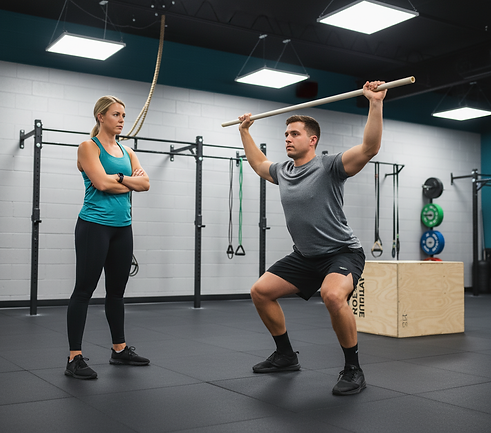
A specific pattern shows up constantly in lifters: the heavier the set, the more tension shows up in the neck and traps, sometimes enough that the neck aches for days after a heavy squat, deadlift, or overhead press that never touched the neck directly.
This usually has little to do with your neck being too weak for the weight on the bar. More often, it is a sign that your body is borrowing stability it has not yet learned to create somewhere else, usually through the core and the breath, and the neck and traps are stepping in to help. Gripping the bar too hard, breathing incorrectly under load, or bracing through the jaw and neck instead of the midsection are common substitutions, and they show up most clearly exactly when the weight gets heavy enough to demand real stability.
Neck tension under a heavy bar is not weakness. It is your body borrowing stability from somewhere else.
None of this means you need to stop lifting overhead or heavy. It means the neck tension is a clue pointing toward a bracing and core stability gap, not a reason to avoid the lift altogether.
LONG-TERM PREVENTION
Building a Neck That Can Handle a Full Day, Not Just a Good Five Minutes
Getting out of pain and building a neck that holds up are two different milestones. Long-term resilience depends on a few things a quick stretch cannot provide.
-
Train endurance, not just strength: the deep neck flexors and upper back need to hold a position for hours, not just move weight for a few reps. Endurance-specific training closes a gap general strength work often misses.
-
Break up sustained positions deliberately: the position itself is usually not the problem. Staying in it without variation for hours at a time is. Regular movement breaks matter more than finding one correct posture.
-
Keep your upper back and shoulders in the plan: a stiff thoracic spine or an underprepared shoulder routinely shows up as neck pain, even when the neck itself was never the actual limitation.
-
Progress overhead and loaded neck positions deliberately: sudden increases in overhead lifting, contact in sport, or new training positions are common triggers for flare-ups. Build capacity ahead of the demand.
-
Address old injuries fully: a previous whiplash injury or neck strain that was never fully rehabilitated is one of the most common hidden contributors to recurring neck pain and headaches.
-
Pay attention to sleep and stress, not just training: poor sleep and high stress both raise how much baseline tension your neck and shoulders carry, and that baseline tension affects how well you tolerate everything else you ask your body to do.
NECK PAIN AND HEADACHES
Every client starts with a thorough evaluation covering your symptom history, your activity and training goals, and a full movement assessment of your neck, upper back, and shoulders together. From there, we build an individualized plan combining mobility work, progressive strength and endurance training, movement retraining, and hands-on treatment when it will genuinely accelerate your results.
As symptoms improve, the focus shifts from calming things down to building resilience: preparing your neck, and the upper back and shoulders connected to it, to handle a full workday, a full training session, or both, without the tension or headaches creeping back in.
What to Expect During Neck Pain Treatment at EVO
WHEN TO SEEK CARE
Some shoulder soreness settles down on its own within a few days. But certain signs suggest it is time for a real evaluation rather than more waiting.
-
Pain or stiffness that has lasted more than two or three weeks without meaningful improvement
-
Headaches that keep recurring, especially ones that track with neck stiffness or a specific position
-
Numbness, tingling, or weakness radiating into your shoulder, arm, or hand
-
A reduced ability to turn or tilt your head that is not improving
-
Neck pain following a car accident, a fall, or a collision during sport
-
Training interruptions or a growing list of positions and movements you have started avoiding
If you are experiencing sudden, severe neck pain following significant trauma, or numbness, tingling, or weakness that is progressively worsening, seek medical evaluation right away. For the gradual, recurring, or nagging neck pain and headaches most active adults experience, a proper movement assessment is where the real answer starts.
Signs Your Neck Needs a Real Evaluation

FREQUENTLY ASKED QUESTIONS
Common Questions About Neck Pain Treatment
Do I need physical therapy for neck pain, or will it go away with rest and stretching?
Some neck soreness from an awkward night of sleep or a hard workout settles within a few days. Neck pain that lingers past two or three weeks, keeps returning, or comes with headaches is usually telling you that the muscles supporting your neck are not yet able to handle what you are asking of them, which stretching alone will not fix.
Is my posture actually causing my neck pain?
Posture is one factor among several, not the sole cause, and it is not just about how you sit. What matters more is how long you sustain any one position without variation, whether your neck and upper back have the endurance to support that position, and what else might be keeping your neck tense before you even sit down, since sleep quality, stress, and workload all play a role. We look at your whole picture rather than assigning blame to a single habit.
Can neck pain really cause headaches?
For a specific subset of headaches, yes. Headaches that begin at the base of the skull, often on one side, and track with neck stiffness or a specific position are frequently connected to the neck. Not every headache works this way, and part of a proper evaluation is figuring out whether yours does.
Can I keep lifting or training with neck pain?
In many cases, yes, with the right adjustments. Neck tension during heavy lifting is often related to bracing and core stability rather than the neck itself being overloaded. The specific pattern of your symptoms tells us a lot about what is actually driving them and what needs to change.
What actually causes neck pain in active adults?
Far more often than people expect, neck pain comes down to an endurance or mobility gap somewhere in the neck, upper back, or shoulders, rather than a single structural issue. Sustained positions, training demands that increased faster than your neck was prepared for, and old injuries that never fully resolved are common underlying drivers, regardless of where the pain itself shows up.
How do I stop my neck pain and headaches from coming back?
By building the specific capacity that was missing in the first place, not just calming symptoms down. Endurance training for the deep neck flexors and upper back, consistent movement throughout the day rather than long static holds, and addressing any old injury that never fully resolved are what actually change the pattern long term.
EVO PERFORMANCE THERAPY
Build a Neck That Can Actually Handle the Job
Neck pain and headaches do not have to mean a permanently modified workday, a training log full of exercises you have quietly stopped doing overhead, or accepting tension as just part of being busy. With the right assessment, a plan built around the actual demands your neck is facing, and a team that understands what you are asking your body to do, most active adults and professionals get back to training, working, and moving through a full day without the tension creeping back in.
Schedule your Performance Therapy evaluation today and find out what your neck actually needs to hold up its end of the job.
Ready To Get Started?
Schedule a Performance Therapy Evaluation
Move Better. Train Stronger. Feel Confident Again.
615-266-5599 | evoperformancetherapy.com